


Nuove traiettorie IT/EN
€ 22,00Nuove Traiettorie (‘New Trajectories’) is the special mention and artist residency programme, born within Giovane Fotografia Italiana | Premio Luigi Ghirri, that each year brings a young Italian photographer to Stockholm, to the Italian Cultural Institute, where the work produced is then presented in an exhibition. The winners of the last three editions, whose work is gathered in this volume, are Eleonora Agostini with Leave the Door Open (2023–2024), Claudia Amatruda with Hypersea (2024–2025) and Erdiola Kanda Mustafaj with Un volto non comune (An Uncommon Face) (2025–2026).
The word ‘trajectory’ alludes to movement, a central concept of the whole project that unfolds in several senses. The ‘new trajectories’ are, first and foremost, those of contemporary Italian photography, trends that Giovane Fotografia Italiana has been mapping and supporting for over a decade. They are also those the three artists had to chart during their residency, reinterpreting their research in dialogue with the Swedish context and with the Institute’s far from neutral space, designed by Gio Ponti.
Eleonora Agostini takes walking as her method. In Leave the Door Open, driven by the need to get to know a new place in a short time, she explores Stockholm on foot and builds the work around nature and the home, two primordial elements shared by the Swedish and Italian imaginaries. Images of dense, impenetrable nature alternate with those of the residence interiors, seemingly steeped in calm and silence yet unsettled by small hints of disorientation and unease. In the exhibition, framed photographs alternated with large immersive walls, conceived to bring the vegetation into the Institute’s rooms.
For Claudia Amatruda, the starting point of Hypersea is water, the element that gives rise to every form of life and connects them all. The artist approaches the theme through research in Stockholm’s science museums and in the natural spaces surrounding the city. She then imagines new hybrids inspired by aquatic creatures such as ammonites and marine mammals, interweaving biological and cyborg elements. The body, experienced as a limit or a trap, becomes an occasion to reflect on transformation and on the intimate relationship between organism and prosthesis, within a practice that also moves through self-portraiture. In the exhibition, installation, video and photography coexist in an organic narrative, while one of the most intense performances was filmed in the Institute’s auditorium and later screened in that same space, in direct dialogue with Ponti’s architecture.
Erdiola Kanda Mustafaj’s work, finally, takes its cue from the lecture Joseph Brodsky gave in Stockholm in 1987 on receiving the Nobel Prize, in which the writer argues that language, not land, is our only true homeland. Un volto non comune carries this idea into visual language and turns photography into a living archive, able to preserve what has passed and to give back what still inhabits everyday life. The project sets two personal archives in dialogue: the images of Maria Jaconelli, a Swede of Italian descent with whom the artist forms a deep bond, and those newly made during the residency. In the exhibition, photographs and negatives on retro-illuminated lightboxes, alongside video and archival material, build a sequence that crosses two worlds and two times. Human presence never appears directly, but can be sensed through its traces: abandoned chairs, building façades, a light left on. In the background resonates the reflection on displaced Italianness that underlies Ponti’s own project.
 -5% OffOriginal price was: € 35,00.€ 33,25Current price is: € 33,25.
The book is available to pre-order, with shipping beginning in February 2027.
For orders from the USA, the UK and Bulgaria, we kindly invite you to contact our local distributors: Oak Knoll (USA), Art Data (UK) and op34.studio (Bulgaria).
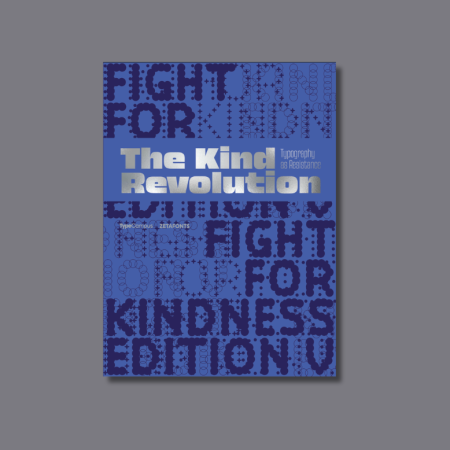
The Kind Revolution: Typography as Resistance explores kindness as an active choice and a form of resistance in a world shaped by conflict, polarisation and arrogance. A selection of 600 typographic posters, submitted in response to the fifth edition of the international Fight for Kindness call and representing 83 countries and 43 languages, celebrates the power of kindness. Through typography and design, participants turn reflections on empathy, inclusion, respect and responsibility into visual statements that challenge the status quo and inspire positive change.The collection features internationally renowned designers and emerging talents, including guest contributors Alan Kitching, Stephen Price of Stash, Stuart Watson of Nomad Studio, Stefano Cipolla with Emiliano Ponzi, An Chen, Armando Milani, Rik Oostenbroek, Emmi Salomen, Marina Willer and Cam Evans of Pentagram London, Silvana Amato, Dan Matutina, Kinda Ghannoum, Ibrahim Zaki and Hala Al Afsaa. The book also includes interviews with the guest contributors and a foreword by James Victore.
Launched in 2022, Fight for Kindness has grown into a global cultural initiative connecting creative communities through design. To mark and promote World Kindness Day, its fifth edition opens a global exhibition season across Europe, Asia and the Americas. A typographic lookbook completes the publication, exploring how typography can speak beyond words, make ideas visible and turn visual communication into a force for change.
The project is promoted by Zetafonts Foundry, an independent, award-winning type foundry founded in Florence in 2001 by Cosimo Lorenzo Pancini, Francesco Canovaro and Debora Manetti. The foundry is internationally recognised for its ability to combine tradition and innovation, and collaborates with global brands such as Google, Apple, the European Commission, Disney, Fox Sports, Rai and Warner Bros.
The initiative is managed by TypeCampus, the cultural department of Zetafonts, which for over twenty-five years has promoted typographic creativity through academic programmes, classes, workshops, mentorship and support activities for agencies and designers. With The Kind Revolution, TypeCampus and Zetafonts reaffirm the value of design as a tool for global connection and dialogue: an invitation to discover how typography can become a visual voice capable of inspiring kindness, empathy and positive transformation.
A project by
Typecampus & Zetafonts: Debora Manetti, Shrishti Vajpai,
with Cosimo Lorenzo Pancini and Francesco CanovaroBook Design
Shrishti Vajpai, with contributions by Sofia BandiniForeword by
James VictoreContributions by
Alan Kitching, Stephen Price of Stash, Stuart Watson of Nomad Studio, Stefano Cipolla with Emiliano Ponzi, An Chen, Armando Milani, Rik Oostenbroek, Emmi Salomen, Marina Willer and Cam Evans of Pentagram London, Silvana Amato, Dan Matutina, Kinda Ghannoum, Ibrahim Zaki and Hala Al Afsaa.17 x 23 cm
448 pages
Trade Paperback with Flaps
English
ISBN 9788898030972
First edition February 2027
Monogrammi IT
€ 28,00The book has been realized in collaboration with Fabrizio Falcone.
Monograms, the most elementary of letter combinations, paradoxically offer great opportunities for expressive creativity. Just two well-drawn letters can have more appeal and communicative power than a logotype made up of six.
Legibility is sometimes replaced by a visual puzzle: the image created by the letters is so compelling that the viewer accepts the challenge of deciphering them, and is “rewarded” with the satisfaction of having solved an enigma. This balance between complexity and seduction runs through almost two and a half thousand years of history and distinguishes the monogram from the logo, a marketing tool that emerged only at the end of the nineteenth century.
The book traces the history, design and applications of monograms over more than two millennia: from ancient Greek coins to medieval and Renaissance documents, from architecture to embroidery, and on to contemporary graphics and animated monograms. The first part of the book investigates the historical developments from ancient Greece to the modernism of the 1930s; the second examines five very different genres from the Second World War to 2024, a mere eighty years that count for as much as the previous two thousand, thanks to the creativity unleashed by the demands of consumer society and the rise of the graphic designer.
With over five hundred illustrations accompanied by critical analysis and the designers’ own words, this is the first volume to offer a serious historical and critical treatment of the subject: a resource for design historians and a source of inspiration for graphic designers, type designers and calligraphers.
Text
James CloughWith the collaboration of
Fabrizio FalconeForeword
Steven HellerBook design
Bunker, Fabrizio Falcone16.5 × 23.5 cm
256 pages
Paperback
Language: ItalianISBN 978-88-98030-53-8
First edition October 2026 € 27,50
Antologia di cultura grafica is the series Lazy Dog dedicates to the history of visual communication. Edited by Alessandro Colizzi and Silvia Sfligiotti, joined from time to time by one or more guest editors, the series offers a sequence of volumes organised around a theme or an era. Each volume brings together a wide-ranging collection of texts and images of historical importance, often previously unpublished or long out of print, each accompanied by a commentary and introduced by an essay in which the editors survey the places, figures and events considered central to the subjects addressed.
How many forms can data take? How do numbers turn into images, and images into knowledge? The fourth volume in the series explores the long history of data visualisation, from the earliest graphic representations of physical qualities in the late Middle Ages through to the digital tools of the third millennium.
The anthology gathers texts by the authors who helped define the visual language of statistics and information: from the fourteenth-century philosophers who prefigured the idea of Cartesian space, to Otto Neurath, theorist of Isotype, to Jacques Bertin, whose Sémiologie graphique laid the theoretical foundations of modern data visualisation, and on to Catherine D’Ignazio and Lauren F. Klein, who reconsider its principles from a feminist perspective.
A common thread runs through centuries and disciplines, from historical cartography to experimental physiology, from propaganda to contemporary debates on the political value of visualisation. It shows how the visual representation of data is never a neutral choice, but always implies a position — scientific, political or aesthetic — in relation to the world it describes.
—
Edited by
Silvia Sfligiotti and Luciano PerondiBook design
BunkerTexts by
American Statistical Association, Matteo Azzi, Jacques Bertin, Giorgio Caviglia, Émile Cheysson, Jacobus de Sancto Martino (attributed to Nicole Oresme), W.E.B. Du Bois, Tommaso Elli, Leonhard Euler, Antoni Jaźwiński, Giorgia Lupi, Lev Manovich, Étienne-Jules Marey, Michele Mauri, Charles-Joseph Minard, Franco Moretti, Otto Neurath, William Playfair, Joseph Priestley, Hans Rosling, Anna Rosling Rönnlund, Ola Rosling, John Snow, Mary Eleanor Spear, Giorgio Uboldi, Vsevolod Vasil’evskij, Emma WillardAnd contributions by
Louis Agassiz, Abū al-Rayḥān, Adriano Attus, Dominikus Baur, Hugh W. Calkins, Gioacchino da Fiore, DensityDesign Lab, Sergei M. Eisenstein, Futurefarmers, Daniel Goddemeyer, Gyeongseong Ilbo, Olivia Johnson, Josh On, Jan Lenica, Duane F. Marble, Randall Munroe, Michael Najjar, Florence Nightingale, Elizabeth P. Peabody, Robert Plot, Júlia Rabetti Giannella, Werner Kolewinck, Matthew H.P.R. Sankey, Jaime Serra Pabou, Moritz Stefaner, Friedrich Straß, Roger F. Tomlinson, Awo Tsegah, Domenico Vandelli, Gwendolyn Warren13.5 × 21.5 cm
276 pages
Paperback with flaps
Italian
ISBN 978-88-98030-55-2
Available from September 2026
Magarìe IT
€ 28,00Magarìe is an illustrated book that tells a hundred years of family history through stories passed down by word of mouth: curses spoken in anger that came true, werewolves, the dead returning to the table on the night of October 31, spirits that lure travelers off the path, ancient rites passed down only among women and only on feast days.
The narrating voice is the author’s own. She weaves together the stories of two families: one Calabrian, rooted in the villages of the Sila, the other Piedmontese, settled in the Canavese. Two very distant worlds, yet joined by an invisible thread made of beliefs, dialects, and the dead who never stop inhabiting the world of the living.
The episodes unfold across a span from 1915 to the 1990s: a birth that may owe its being a girl to a grandmother’s curse; a magnetic great-grandfather who dies young, asking his wife to follow him into the afterlife; an uncle who cuts through the woods on the night of the feast and can never find his way back; deafness passed from mother to daughter like a silent inheritance. And finally the unraveling: the rite to free oneself from the evil eye, which the grandmother hands down to her granddaughter just before her own memories begin to fade too.
Elisa Talentino’s illustrations, made in watercolor and pencil with touches of bright red, build a visual archive of this everyday supernatural: female figures in dark clothing, courtyards suspended in time, bleeding mushrooms, tables laid for the absent. Magarìe is a story of double roots and inherited wonders, a book that holds documentation and enchantment together.
—
Texts and illustrations
Elisa TalentinoBook design
Bunker19 × 27 cm
112 pages
Paperback with a clear dust jacketItalian
Isbn 978-88-98030-50-7
First edition September 2026
Looking Good EN
€ 38,00The book is available for pre-order and will ship from July 2026.
Looking Good is a compendium of Charles Traub’s photographs on the nature of wandering and the gaze itself, a central preoccupation of his art.
It brings together images from the mid-1970s to the present. As George Sand wrote, “the secret of the study of life lies in learning to use one’s eyes,” and Traub has pursued this study through more than fifty years of photography. People watch each other, watch Traub, stare into the void, wander in search of something to catch their attention. These are mostly candid photographs that capture the nuance of the fact that we are always in the act of observing.
What you discover, looking the way Traub does, is that in some sense we are all performers, aware or unaware, putting on different faces in the moment we are seen and see others. “The content is a glimpse of something, an encounter like a flash, it is enormously momentary.” (Willem de Kooning)
—
Photographs
Charles H. TraubText
Natasha A. ChukEditing
Yan JinBook design
Bunker21 × 28 cm
120 pages
Hardcover
EnglishIsbn 978-88-98030-94-1
Available from July 2026 € 24,00
Fantastic stories for real objects was born from the desire to tell the story of objects designed by the Castiglioni siblings, in particular Achille and Pier Giacomo, through an entirely original narrative lens.
Making room for the imagination, serious texts have been transformed into fantastic tales: genuine fairy tales conceived for adult-children. Behind every object lies a story, a dream, a two-way relationship with its creator.
Achille Castiglioni saw in “anonymous” objects a latent potential, collecting them and letting them mature in his mind until they became something new and extraordinarily real. This creative process, built on continuous research and reinterpretation, is told here through short stories that weave together moods, thoughts, and the design journey of those objects we now call “design classics.”
The stories, accompanied by illustrations, comics, and photographs, seek to capture the essence of the Castiglioni creative process, blending fantasy and reality with the freshness and irony that are intrinsic qualities of the family.
Each tale closes with a fact sheet that brings the reader back to the tangible reality of the object, completing a journey that begins in imagination and arrives at the real.
—
Texts by Carlo and Livia Castiglioni
Illustrations by Andrea Galanti
Afterword by Dario Scodeller
Book design Bunker16.5 × 23 cm
200 pages
Paperback with dust jacket
EnglishIsbn 978-88-98030-98-9
First edition May 2025 € 70,00
Piccolo albero (Little tree) is considered one of Katsumi Komagata’s absolute masterpieces: a pop-up book awarded at the Les plus beaux livres français competition in 2009 and recipient of a special mention at the BolognaRagazzi Award in 2010.
In this work, the Japanese designer reaches the pinnacle of his formal and narrative research, merging artisanal rigour with poetic delicacy. The book explores the universal themes of the cycle of life through a powerful natural metaphor. Between two white pages, a tiny tree is born, growing and changing through the seasons: leaves unfold, branches stretch, colours shift, the tree ages and finally disappears, leaving behind a seed that ensures its continuity.
The strength of Piccolo albero lies in a narrative that favours sensory perception over words: folds, textures and die-cuts guide the reader through a tactile and contemplative experience, a meditation on transformation, time and the fragile beauty of life.
About the book, Komagata has written: “I lost my uncle some time ago. Before losing someone, we cherish their presence; afterwards, we feel their absence. I chose this paper so that readers might touch it, as well as see it.” Piccolo albero thus becomes a bridge between nature and humanity, a narrative object that invites us to observe, wait and embrace the secret rhythm of life.
Text and illustrations
Katsumi KomagataBook design
Katsumi Komagata26 × 21 cm
32 pages
Hand-sewn hardcover
Italian/JapaneseIsbn 978-88-98030-87-3
First edition May 2026



 -4% OffOriginal price was: € 83,00.€ 80,00Current price is: € 80,00.
The volume Alfabeti Modernisti Italiani collects over one hundred specimens of metal and wood movable type produced in Italy between the 1920s and 1940s, systematically organized into categories and subcategories: functional, cyclopean, triennial, synthetic, modulated, decorative, and modular. The book provides historical context, offering a clear mapping of the typefaces produced in Italy during this period.
Luca Lattuga’s research, realized in this volume, is an essential tool for exploring a little-studied phenomenon, shedding new light on a coherent and recurring style largely overlooked by traditional typographic historiography, emerging from small workshops and foundries, the so-called “basso.”
The significance of Lattuga’s work extends to contemporary practice: the digital foundry CAST has reinterpreted twenty-five of these typefaces, now available as digital fonts in the Alfabeti Modernisti Type Specimens collection, published by Lazy Dog alongside the volume, as explained in the introduction by Riccardo Olocco. In this way, Alfabeti Modernisti Italiani is not only studied historically but continues to influence contemporary typographic design, demonstrating the vitality and coherence of a cultural and aesthetic heritage often forgotten.
 -15% OffOriginal price was: € 47,00.€ 40,00Current price is: € 40,00.
Armando Milani’s Peace Poster, part of a triptych together with the War and React posters, was made in 2004 and adopted by the UN for its 60th anniversary.
Incontri is a sui generis memoir, which Armando Milani gives us to capture through flashes, fragments and interweavings the fundamental encounters that have most influenced his work and inspired his creative choices
 -25% Off
Photography Starter Kit IT/EN
Original price was: € 160,00.€ 120,00Current price is: € 120,00.With Dolce Via Nova we are in the early 1980s on a journey from Milan to Marsala. The book recounts the journey of Charles H. Traub, guided by Luigi Ghirri, during which the American photographer composed an ironic and spontaneous portrait of an Italy that today we cannot say whether it really existed.
The Picture Man recounts the ‘film life’ of Gusmano Cesaretti, one of the most authoritative voices of early American street photography. The book traces it thanks to an interview conducted in 2018 by young photographer and creative director Stefano Lemon
Invisible is a 168-page book with over 100 photographs. It is the restitution of meticulous archive research from which many previously unpublished shots by Franco Fontana, the undisputed master of colour, emerged.


Work with us
Are you a bookshop?
Readers